
Most of the advanced skin and hair treatments that are offered at Skin Clinics in Chandigarh today require a good understanding of clinical skin assessment and various skin conditions to deliver effective results. Medical Dermatology forms the core of all services to offer specialist Skin and Dermatology assessment and treatment for various conditions of the skin, including acne, pigmentation, hair loss, and various types of skin infections. Many of these skin problems affect older persons.
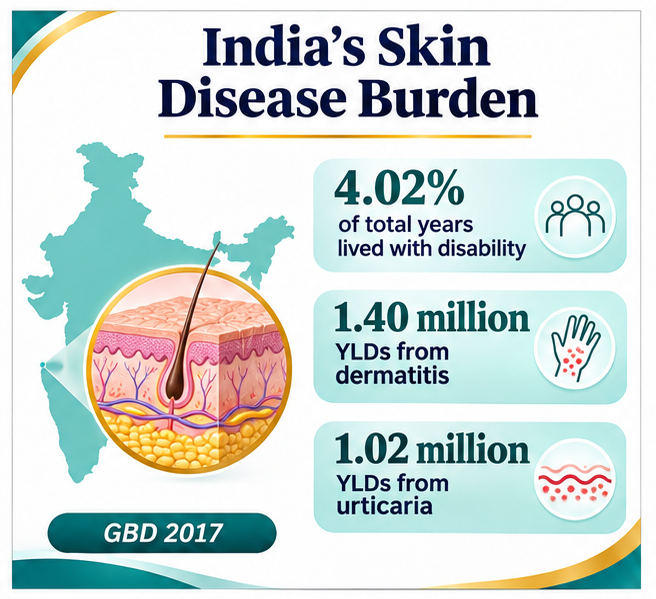
Dermatology accounts for 4.02% of total Disability-Adjusted Life Years (DALYs) causing disability for all diseases in India. As compared to 1990, the total years of disability have increased from 4.07 million years to 6.26 million years in 2017.
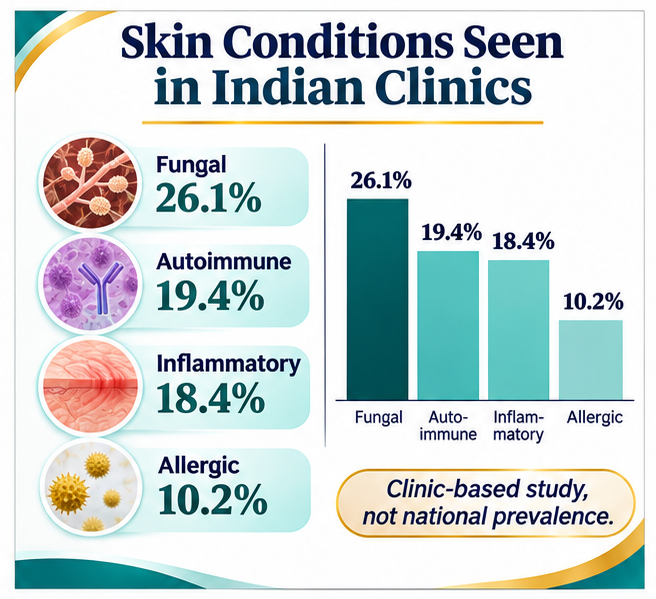
In a study conducted on 6,169 patients from four different parts of the country, it was found that 26.1% of the total cases were suffering from fungal skin infections. Autoimmune disorders such as lupus were found in 19.4% of cases, and other inflammatory diseases affecting the skin in 18.4% of cases.
Thus, our study dispels the widespread notion that dermatology is all about ugly-looking skin. As all diseases of the skin have symptoms that create discomfort to patients, and persist for a long time to possibly even impair a function, there is nothing but benefit to have these evaluated and thus treated by a Dermatologist in Noida.
At Skin and Hair Clinics of Dermatologists in Noida (Skin Cowski), we evaluate and treat acne, pigmentation, hair loss, and a host of other skin problems in patients who consult Dermatologists in Noida for their skin and hair problems. Now, the major challenge in dermatology in India is to correlate evidence-based dermatological diagnosis with appropriate medical dermatological treatment and with suitable aesthetic or non-medical dermatological treatment.
1. India’s Skin Disease Burden Extends Beyond Cosmetic Concerns
Skin conditions contribute substantially to disability in India.
Dermatitis accounted for 1.4 million years of life lost due to disability (YLDs) and urticaria 1.02 million years of life lost due to disability in 2017, Global Burden of Disease.
Similarly, the amount of Disability produced by several of the infectious diseases of the skin is the same as that of the non-infectious diseases.
These diseases, in turn, constituted about 30% of total Disability caused by all skin and subcutaneous diseases as analyzed in the Global Burden of Disease (GDB) study. Various such infectious conditions affect different patient populations and thus require different strategies for treatment.
Different fungal, viral, and scabies diseases affect different populations of patients and thus require different approaches to treatment.
Fungal skin infections need to be treated with antifungal medication. All the other skin diseases can be treated by restoring the skin’s barrier function and tackling their causes. Some of these are prescribed by a dermatologist.
No cosmetic treatment will cure all these fundamental problems of the skin.
In the future of dermatology, the cure of skin diseases will have top priority, and their cosmetic treatment will follow.
2. Fungal Infections Remain a Major Clinical Concern
The study included 415 dermatologists from 4 different regions of the country (Northern, Southern, Eastern, and Western regions of India).
Out of 6,169 patients studied across the country, 26.1% had fungal infections.
In clinic-based studies, it is important to know the prevalence of various fungal infections in dermatology.
The second multicenter study included 41,421 patients of 415 dermatologists from northern, southern, eastern, and western regions of the country. The study screened the patients for dermatophytosis and found lesions of non-hairy skin in 7,174 cases.
Out of 7,174 cases of dermatophytosis affecting non-hairy skin parts of the body, 27.9% were cases of chronic or recurrent dermatophytosis.
Out of these 7,174 cases of dermatophytosis affecting non-hairy skin, 27.9% were cases of chronic or recurrent dermatophytosis. There was a history of misuse of topical corticosteroid creams in 50.9% of the patients with chronic or recurrent dermatophytosis.
Data for persistent skin infections have to be correctly recorded and treated.
Every time an unsuitable cream is used to treat a persistent skin infection, it can change its appearance. Thus, delayed correct treatment and possible complications can result.
3. Acne and Pigmentation Require Individualised Assessment
Acne and Pigmentation are two of the most common skin conditions for which people seek help from a dermatologist for their skin problems.
Even though there are effective skin care measures for acne and pigmentation, these have to be adapted to the individual and not simply applied to everyone with similar skin problems.
Acne can be influenced by a number of factors, including inflammation, hormonal activity, increased oil production, and follicular obstruction.
Pigmentation can arise as a result of inflammation of the skin, or as a result of damage caused by the sun, hormonal change, or skin disease.
Treatment depends on identifying the specific problem.
Active acne can be treated with medical therapies, whereas patients with residual acne scars or pigmentation need individualized procedures which have to be chosen after a case-specific assessment.
Cosmetic treatment modalities, including chemical peels, have their own role in the management of various skin disorders, but response to treatment varies from individual to individual.
There is a greater chance of post-inflammatory pigmentation in patients of darker skin types. Hence, they require special care in managing their scars.
Conservative treatment planning, proper obtaining of informed consent of patient and good aftercare are crucial in such cases.
4. Misuse of Steroid Creams Highlights a Patient-Safety Gap
Misuse of Steroid Creams for Facial Skin Problems: A Growing Patient Safety Problem in India.
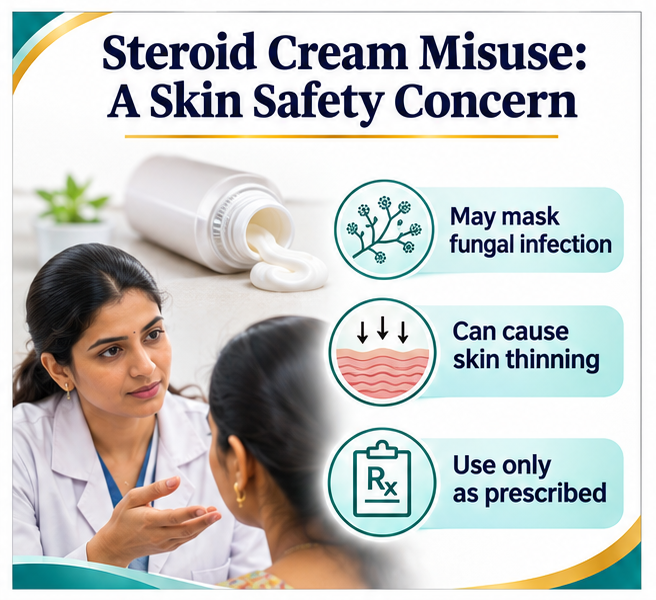
In a prospective multicenter Indian study of 2,926 patients with facial skin disorders, 433 (14.8%) patients were on topical corticosteroids.
The other study, however, refers to the specific population of patients seen in that clinical setting of the Department of Dermatology in that hospital in New Delhi. The figures, however, are an important marker of a potential patient safety problem of recurring nature in health education programs in that country.
Figures from the two studies presented above relate to specific patient populations and not the whole of India.
Nevertheless, they demonstrate a recurring patient-safety concern.
Use of potent topical steroids without supervision can lead to thinning of skin, color changes, formation of acne-like lesions, or worsening of fungal infections.
Moreover, the abuse of various combinations of cosmetics for unsupervised use in health education programs should be discouraged, and appropriate treatment explained to patients.
5. Aesthetic Dermatology Needs Clear Clinical Standards
Thus, apart from managing scars, hyperpigmentation, aesthetic aging changes and various idiosyncratic cosmetic concerns, aesthetic dermatology encompasses a variety of other treatments.
While it is important to increase the number of aesthetic treatments, it is equally as important to practice aesthetic dermatology responsibly.
It is important to remember that procedures like laser, fillers, and other energy-based devices need to be given in a clinical setting with appropriate patient selection, adequate operator skill, and management of any possible complications.
One treatment does not fit all. Different treatments are needed for different individuals depending on various factors like active infections, certain medications, sensitive skin, or underlying medical conditions.
Equally important is discussing realistic outcomes.
Just because a single treatment is sufficient to improve a problem does not mean the problem will go away forever. Most aesthetic problems need to be treated from time to time and even on a long-term basis.
A patient’s degree of satisfaction is also a parameter to be evaluated in addition to safety, cure of symptoms, and duration of treatment.
6. India’s Next Priority Is Evidence-Based, Integrated Dermatology
Thus, future strategies in dermatology for the country must integrate medical care, health education, and treatment in a follow-up approach to the health of patients.
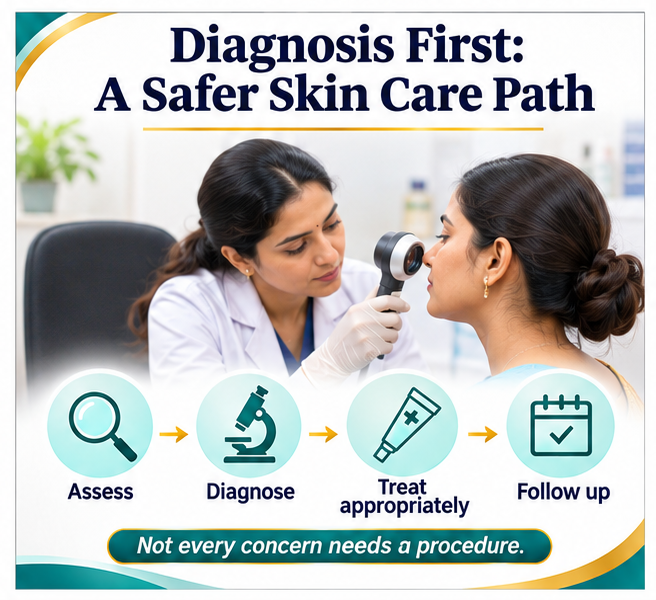
Therefore, patients with persistent rashes, recurrent skin infections, hyperpigmentation not explained by prior history of skin disease or worsening acne should receive a diagnosis-led approach to care.
Monitor the patient’s response to the treatment, watch out for any possible complications, and explain to the patient why you wouldn’t recommend a particular treatment even if he asks for it.
Incorporating technology like digital imaging for clinical evaluation will not replace the clinician’s judgment.
Thus, the end objective of dermatology in a patient’s life would be best served by a healthcare provider seeking to offer the very best of skin care in the form of a treatment or a medicine or even healthy skin care or possibly even a surgical intervention followed by appropriate observation for any adverse effect.
Conclusion
Dermatology in India has a lot more to offer than just increasing numbers of aesthetic procedures.
Apart from many infectious, inflammatory, and chronic skin diseases, misuse of skin medicines is a big problem waiting to be tackled.
Now it is time to take a giant step in safe skin care by accurate diagnosis and treating the patient with good safety and the best treatment option with good long-term results.
The future of dermatology in India will be evaluated not only by the increasing number of aesthetic procedures but by the quality of skin care given to patients on an ongoing basis.