
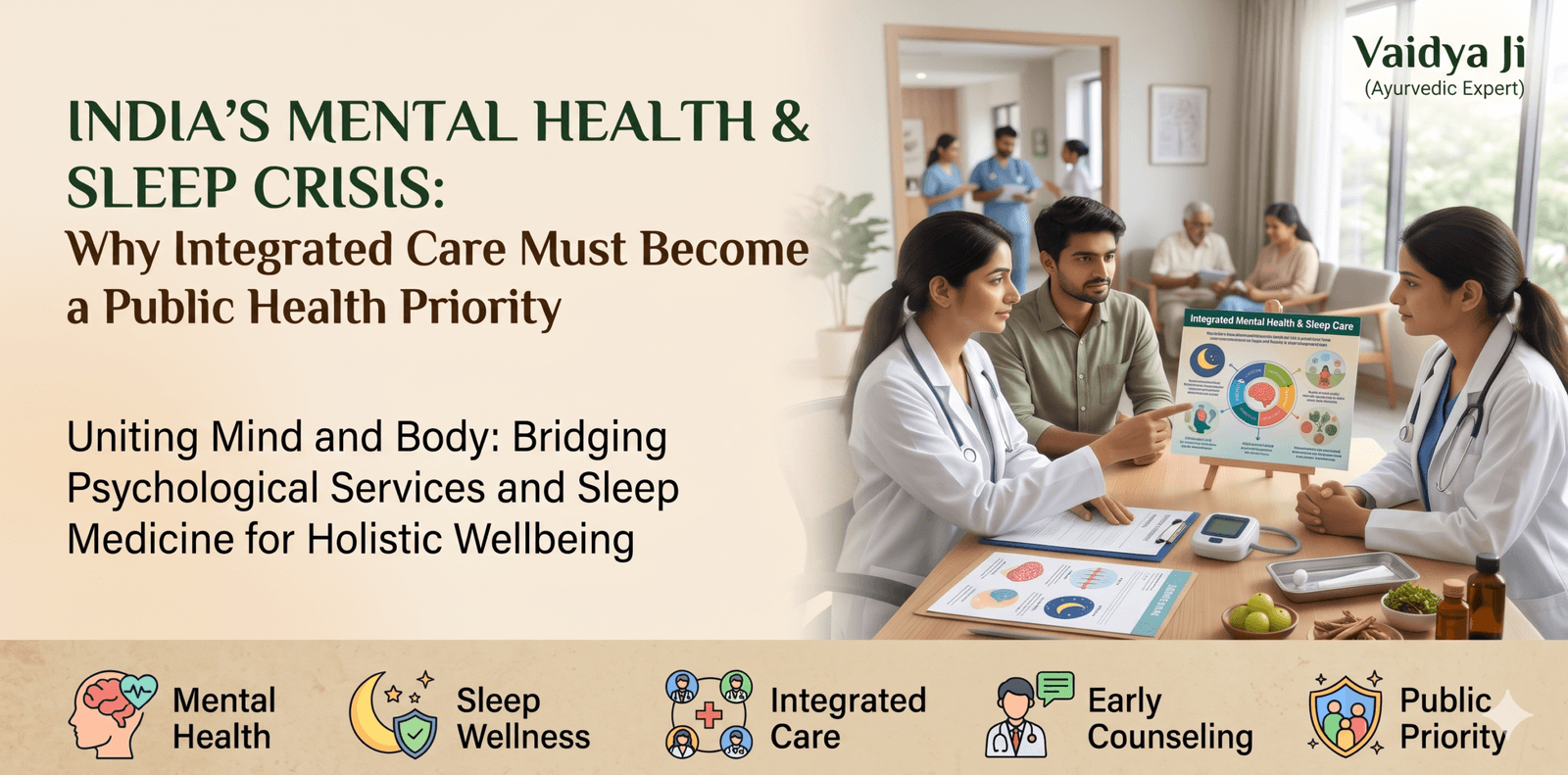
There is a slowly dawning awareness in the country’s health care system of the interlinkages of mental health and sleep. While it is true that some of the major mental health disorders like anxiety, severe depression, psychotic disorders, etc., can present with disturbed sleep, there are other psychiatric conditions as well that can be accompanied by disturbed sleep. Moreover, there are several sleep disorders that are being presented as distinct entities. A Psychiatrist in Mumbai can be of great help in evaluating a person who needs mental health assessment as well as treatment for disturbed sleep.
The National Mental Health Survey (NMHS) 2015–16 conducted by NIMHANS, estimated that 10.6% of the adults with Indian Shield, as defined in the survey, suffered from mental disorders at any given time. The lifetime prevalence for mental disorders was estimated to be 13.7%.
For sleep disorders in India, a systematic review and meta-analysis of 100 studies published till 2025 reported a pooled prevalence of 25.7% for insomnia, 37.4% for obstructive sleep apnea, and 10.6% for restless legs syndrome. The estimates varied greatly across studies. Thus, the above figures cannot be considered as the estimates for the entire country.
The areas of mental health and sleep disorders have much overlap, and therefore it is also important to note that poor sleep can worsen emotional distress, but at the same time mental health problems such as depression, anxiety and stress can cause problems with sleep, including difficulty in getting to sleep, staying asleep through the night and having low energy on waking in the morning even after having had what seemed to be a satisfactory amount of sleep.
Sleep Disorders Treatment in Mumbai by expert health professionals is also critical to handle sleep-related breathing problems, chronic insomnia, and other related sleep disorders to address health concerns holistically and develop joint health care pathways in the country for psychiatry, sleep medicine, and primary health care.
1. India’s Mental Health Burden Extends Beyond Diagnosis
National Mental Health Survey provides valuable insights into required treatment in India.
Urban vs Rural Prevalence and Treatment in India – NHMS-5 Data for 21 States. “Mental health morbidity was found to be higher in urban metropolitan areas (13.5%) as compared to rural areas (6.9%).”
There was a huge treatment gap in different psychiatric conditions ranging from 70% to 92% in the said National Mental Health Survey report. The treatment gap for common mental health disorders was estimated to be about 85%.
For common mental disorders, the treatment gap approximates to 85%.
Thus, a substantial proportion of people suffering from mental health problems have not received appropriate care from mental health professionals during the time frame of the survey.
There are many reasons for this, including mental health stigma, limited awareness about mental health issues, cost of treatment, and shortage of mental health professionals in the country.
Addressing mental health requires more than just increasing the number of mental health specialists. Improving outcomes requires early detection, good referral systems and continuity of care.
2. Sleep Disorders Are a Significant but Under-Recognised Health Concern
Sleep problems are often viewed as a temporary consequence of stress, work overload, or other lifestyle factors. However, chronic sleep problems can be a medical condition that requires identification and treatment.
However, chronic sleep problems can represent several separate medical conditions.
Community-population prevalence was estimated to be approximately 15.1% for the diagnosis of insomnia, 14.6% for obstructive sleep apnea, and 6.6% for restless legs syndrome in the 2025 Indian systematic review.
These subgroup estimates were found to be lower than the overall pooled estimates in the study setting.
These sleep disorders are defined by an insulin pattern which can lead to impaired activities of daily living, and also other factors. For example, in the case of chronic insomnia, there is difficulty in initiating sleep and/or repeated awakenings, which in turn impairs activities of daily living.
Obstructive sleep apnea (OSA) is defined by repeated upper-airway obstructions during sleep, typically with manifestations of snoring, breathing pauses that are witnessed by bed partners, disrupted sleep, and excessive sleepiness during the day.
The clinical implications extend beyond tiredness.
Sleep disorders that are left untreated can impact a person’s concentration, their work/school activities, and their ability to manage other medical problems.
It is important to diagnose any sleep disorders before attributing a patient’s persistent symptoms to stress.
3. Mental Health and Sleep Influence Each Other
There is a two-way street between psychiatric conditions and sleep disturbances.
Insomnia is often associated with depression and anxiety and can be exacerbated by poor sleep and, in turn, worsen emotional regulation, irritability, and cognitive functioning.
Also, treating one problem does not necessarily solve the other.
The anxiety and insomnia sufferer would benefit from a comprehensive assessment of their psychological problems, sleep, their medication, and the possibility of a primary sleep disorder.
Similarly, someone with obstructive sleep apnea may report low mood or concentration difficulties without having a primary psychiatric disorder.
This distinction affects treatment selection.
Cognitive behavioral therapy for insomnia (CBT-I) is a first-line treatment for chronic insomnia in adults.
For other patients with sleep problems, psychiatric treatment, sleep studies, CPAP (positive airway pressure) therapy, and management of their associated medical conditions may be needed.
Rather than jumping to the conclusion that all problems with sleep need to be treated with medicine, it is better to make an accurate diagnosis and then provide the best treatment for that individual’s circumstances.
4. India’s Mental Healthcare Access Gap Remains Substantial
Mental healthcare is being made accessible to people across the country through various national programs.
As reported by the Ministry of Health and Family Welfare, Tele-MANAS received 47.75 lakh calls from October 2022 to October 2026.
53 cells are operational across 36 states/UTs for Tele-MANAS service.
It offers FREE CONFIDENTIAL MENTAL HEALTH SUPPORT 24/7 over a FREE CALL to the national helpline number 14416.
While technologies can support initial access to services for people at the margins of healthcare (e.g. those geographically isolated or disadvantaged), counseling access is not the same as definitive diagnosis and/or treatment.
Having counseling access does not necessarily mean that a proper diagnosis was made or adequate treatment has been given.
Thus, an effective system for treating fatigued patients will connect initial screening for problems that need psychiatric evaluation, sleep medicine evaluation, and treatment, with necessary continued treatment.
5. Integrated Care Should Become the Next Healthcare Priority
These conditions are currently being treated in separate clinical paths by the primary healthcare system of India for psychiatric problems, respiratory sleep disorders, and other lifestyle-related general medical conditions.
In many cases, the same set of symptoms can have origins in more than one of these categories of health problems.
Fatigue for a long time may be due to poor sleep, or even depression, or side effects of medication, or even an underlying medical illness.
Daytime sleepiness, decreased concentration, and other symptoms may require an investigation that goes beyond simple psychological counseling.
The integrated assessment helps in identifying and treating the condition sooner rather than missing a possible underlying medical condition and starting the wrong treatment.
Primary healthcare professionals should have enough knowledge of a sleep disorder to recognize warning signs, to refer a patient to a specialist for evaluation when necessary, and to follow up on a patient after evaluation.
Sleep quality is an important clinical parameter and should not be clubbed as a parameter for assessing the lifestyle of a patient.
Conclusion
India’s growing mental health and sleep disorder cases make a public health challenge for the country.
Awareness to recognize early signs of distress and the need for specialist evaluation, along with access to quality integrated assessment and treatment for sleep and mental health, is the need of the hour.
Mental health and sleep health are two interconnected but distinct health issues that require a proper assessment in healthcare.
India’s next mental health milestone needs to move beyond the simple metric of the number of consultations delivered to measuring how well patients receive coordinated, evidence-based care that helps improve sleep, psychological well-being, and overall functioning.